
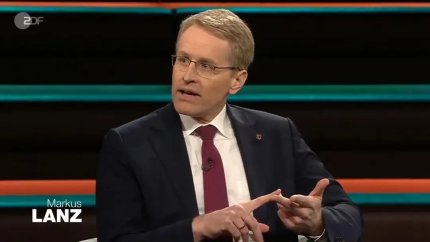
A scandalous statement by Schleswig-Holstein’s Minister-President, Daniel Günther of the CDU, has recently reignited the debate over freedom of expression in Germany. Appearing on the Markus Lanz show last week, the head of the Schleswig-Holstein government said, first, that he wants the democratic opposition party AfD to be banned in Germany; and second, that he more generally favours censorship of government-critical and independent media. He also stated that, if necessary, he would support banning media outlets he does not like. In this context, Günther explicitly named the independent outlet NIUS as an appropriate target for state bans and censorship.
Those in power have always been dissatisfied with the press. That in itself is neither new nor necessarily problematic. The problem arises when such dissatisfaction leads to demands for regulation, censorship, or bans on independent media that report in ways the authorities do not approve of. This is precisely what happened when Schleswig-Holstein’s Minister-President, Daniel Günther (CDU), recently spoke on Markus Lanz. There, Günther openly expressed that certain media should be regulated, censored, and ultimately could be banned. When directly asked whether he meant “regulate, censor, and, in extreme cases, even ban,” he replied without hesitation: “Yes.” His justification was that, in his view, “false information” is being spread on the internet that “attacks democracy.” In the broadcast, however, Daniel Günther provided no concrete examples of the alleged false information that supposedly threatens democracy.
Yet press freedom, as enshrined in Article 5 of the German Constitution, does not apply only to state-funded media that the old governing parties consider trustworthy or well-behaved. It also applies to digital outlets and to independent media that are critical of the government. To demand special quality criteria as a precondition for invoking press freedom is a fundamental misunderstanding of the nature and significance of freedom of expression and freedom of the press in a democracy.
It is particularly problematic that Günther specifically singles out the government-critical outlet NIUS as a purveyor of lies—without presenting any evidence. In doing so, he does exactly what he accuses this media of: making claims without proof. When a powerful politician brands specific media as illegitimate, the suspicion of politically motivated censorship is unavoidable.
Even more troubling is the silence within his own party. When one of the CDU’s most prominent politicians openly advocates interference with the press, it should trigger a principled debate. Instead, there is silence. The same applies to state-funded media in Denmark. This is alarming, because freedom of expression and freedom of the press are not matters of party politics, but of fundamental democratic values.
A democracy does not thrive on uniform, “correct” opinions, but on free debate—even when it is sharp, messy, and uncomfortable. False claims are best countered with arguments, evidence, and open criticism—not with bans. For once the state begins to decide which media may exist, it is no longer the press that holds power to account, but power that controls the press.
Every democrat, including those in the CDU, should take this seriously.
And state-funded media—also in Denmark—should take it seriously as well.