
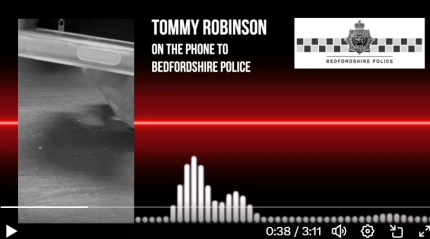
Tommy Robinson has received a phone call from Bedfordshire Police. Not to offer protection, not to present a security plan, not to provide the basic support any citizen in a free society should be able to expect when a terrorist organisation marks him for death.
He was called to be given a message: ISIS has placed him on a list.
And with that begins what ought to be one of the most disturbing stories in recent British history — not primarily because of ISIS, but because of the British state’s response.
The Police Inform — and Do Nothing
The police tell Robinson that his name appears in an ISIS publication calling for violence against him. The intelligence services have seen it, and the threat is considered real.
Robinson naturally asks whether he can see the material himself. He cannot.
He then asks whether he can find it online. At that point the absurdity becomes total: doing so would likely be treated as a terrorism offence.
In other words, the state informs him that he is a terrorist target — while simultaneously making it potentially criminal for him to see the evidence.
A Monopoly on Force Without a Duty to Protect
It is only when the conversation turns to protection that the situation becomes truly grotesque.
The police emphasise that the call does not entitle him to take any “pre-emptive measures”. He must not respond, he must not protect himself, he must not do anything that could be interpreted as self-defence.
The state insists on its monopoly on force — but refuses to use it.
Because the police offer him no meaningful protection. They do not offer to secure his family, they do not offer to take responsibility. They offer nothing beyond information that amounts, in practice, to this: you are on your own.
Two-Tier Policing in Concentrated Form
And here we reach the core of what can increasingly be described as Britain’s two-tier policing.
For years, Britons have watched a legal system crack down hard on citizens for words posted on social media, for “offensive communications”, for the wrong tone, the wrong opinion, the wrong tweet. The state suddenly becomes highly effective when it comes to speech.
But when an Islamist terror organisation identifies a specific man for murder?
Then the police call — and wash their hands.
The phone call carries the chilling character of institutional self-protection: we have informed you, so no one can say we did nothing. If something happens, the authorities can always point out that they warned him.
But that is not protection.
It is paperwork responsibility — bureaucratic self-insurance.
The Silence of the Media
And of course: silence from the British mainstream media.
No major headlines, no demands for action, no public debate. As if Tommy Robinson is still not regarded as a citizen with rights, but as a pariah — a man the establishment would rather see disappear from view.
One does not have to be a conspiracy theorist to notice what is happening. The state today appears more concerned with controlling those who speak about grooming gangs and Islamist extremism than with confronting the forces that threaten violence.
A Principled Breakdown
When a citizen is marked as a terrorist target, and the authorities’ response amounts to: you may not defend yourself, and we have no plan to defend you, then something fundamental has shifted.
The rule of law is not merely statutes and procedures. It rests on a simple contract: the state claims the monopoly on force because, in return, the state protects its citizens. If the monopoly is maintained while protection is withheld, it ceases to be a principle and becomes an instrument of control.
That is precisely why this case extends far beyond Tommy Robinson. It reveals a Britain in which the authorities can be highly energetic when it comes to words — yet strikingly passive when it comes to terror threats, so long as the target is politically inconvenient.
One may call it many things. But one cannot call it safety. And one cannot call it equality before the law.