
In January, Schleswig-Holstein’s Minister-President Daniel Günther triggered a fierce debate in Germany about freedom of speech and the press. Appearing on the Markus Lanz show, he seemed not only to advocate banning the democratic opposition party AfD, but also to argue for state intervention, censorship, and even prohibitions against independent, government-critical media outlets which, according to Günther, spread “false information” and “threaten democracy.”
During the broadcast, Günther specifically mentioned the independent outlet NIUS as an example of a media organisation he believed should face state intervention. He later attempted to backtrack, claiming that the question to which he had answered “yes” concerned only banning social media for minors, not banning media outlets. However, anyone reading the transcript of the interview will find little doubt that Günther himself was responsible for igniting the controversy.
From Party Bans to Media Bans
Nevertheless, prominent journalist Dunja Hayali from the state-funded broadcaster ZDF quickly came to Günther’s defence. In an Instagram post addressing the debate about free speech, censorship and alternative media, she attacked NIUS as a “trash” outlet that manipulated quotations and spread false news.
“Is anyone surprised that this ‘Nius’ video portal takes things out of context, twists them, distorts them, swaps them around and presents them exactly as it suits them? That’s their strategy. Always exactly how they need it,” she told her more than 500,000 followers, adding:
“What I find much more interesting is that there are now politicians who no longer get their information from primary sources, but from this rubbish, and then take it at face value, because of course it fits their agenda.”
Stones from a Glass House
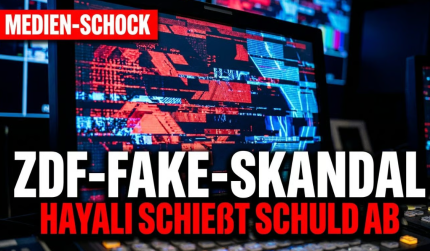
Less than a month later, on 15 February, Hayali and ZDF found themselves at the centre of a media scandal in Germany.
Hayali presented a news segment on ZDF’s flagship news programme Heute Journal, which purported to show brutal actions by the U.S. immigration authority ICE as it deported a woman and two children.
The problem was that ZDF used AI-generated video footage to dramatise the report and presented it as genuine documentary material. The footage had been created using artificial intelligence, yet it was broadcast without any indication that it was not authentic real-world recording. To make matters worse, the segment also included another clip taken from an unrelated news story from 2022.
ZDF was thus exposed as having aired misinformation — most likely politically motivated.
Misinformation on State-Funded Television
Dunja Hayali and ZDF, who had begun by throwing stones at the independent outlet NIUS for being “trash” that spreads misinformation, ended up in a glass house of their own, spreading misinformation on state-funded television.
The ZDF scandal concerns breaches of journalistic standards and politically motivated misinformation in a powerful, publicly funded media organisation. ZDF issued a public apology, corrected the broadcast, removed the AI-generated material, and promised to review its procedures for handling AI-generated content in the future.
But the damage has been done, and public trust in state-funded media in Germany is lower than ever.
A Democratic Problem
In that sense, the ZDF scandal resembles the BBC’s manipulation of video footage from Donald Trump’s speech to Congress on 6 January 2021, as the misinformation was so clearly politically motivated.
Misinformation in state-funded media is more than a journalistic misstep. It is a democratic problem — and it raises a fundamental question: why should citizens not be free to decide for themselves which media they wish to support?