
The Bondi Beach Massacre
The suburb of Bondi in Sydney (along with Melbourne) is home to one of Australia’s Jewish communities. On the first day of Hanukkah, 14 December 2025, many Jews had gathered in Archer Park near Bondi Beach to celebrate the Festival of Lights.
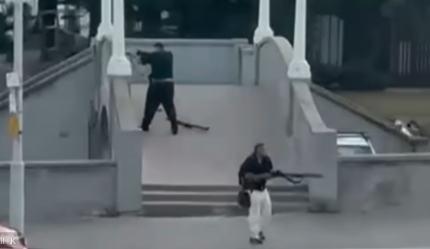
The celebration was abruptly interrupted when Sajid and Naveed Akram (father and son) opened fire on the crowd, killing 15 people. Two Islamic State flags were later found in the perpetrators’ vehicle. It emerged that in October 2025 they had recorded an anti-Zionist video with an IS flag as the backdrop.
Authorities are investigating whether they were inspired by Islamic State ideology but acted independently, or whether they had links to an IS branch operating in the Philippines.
The day after the massacre, Jewish synagogues and schools closed for security reasons. In the weeks that followed, the Jewish community was forced to cancel events to a greater extent than before, and police increased their presence around synagogues.
Antisemitism Has Grown Since 7 October 2023
Since the terrorist attack on Israel on 7 October 2023, antisemitism has been rising sharply in Australia.
On social media, antisemitic postings have increased significantly since that date.
The Adass Israel synagogue in Melbourne, built by Holocaust survivors, was set on fire on 6 December 2024. On 10 January 2025, the Allawah synagogue in southern Sydney was vandalised with swastikas. On 11 January 2025, the Newtown synagogue was similarly defaced, and perpetrators attempted to set it on fire.
On 4 July 2025, an arson attack was carried out at the entrance to the Melbourne Hebrew Congregation synagogue while Jews were celebrating the Sabbath inside.
Several cars have been set ablaze, and vehicles and buildings have been defaced with anti-Israel graffiti.
In February 2025, a widely publicised exchange occurred on a video platform. Max Veifer came into contact with a doctor in a lab coat and a nurse from Sydney. When Veifer introduced himself as Israeli, the man angrily replied: “You will be killed and go to Hell.”
Veifer asked what they would do if an Israeli patient were admitted to their hospital (later identified as Bankstown Hospital). The woman responded: “I won’t treat them, I will kill them.” The man added: “You have no idea how many [Israelis] have come to this hospital, and I sent them to Hell. I literally sent them to Hell.”
Antisemitism Continues
The popular bakery Avner’s in Sydney closed after the Bondi Beach attack. A sign in the window read:
“The world has changed. Our world has changed. After the pogrom at Bondi, one thing is clear: it is no longer possible to ensure open, public, proud Jewish places and events in Australia.”
The bakery had been subjected to near-constant antisemitic attacks for two years and closed out of concern for the safety of staff and customers.
The day after the Bondi Beach massacre, the local business Lox in a Box, which sells Polish bagels and burgers, suddenly received a wave of negative reviews. The owner stated:
“Moments like this reveal the undercurrent of antisemitism that still exists, even here in Australia.”
There is anger within the Jewish community towards Prime Minister Anthony Albanese, who is accused of allowing extremism to grow. Netanyahu has claimed that the Australian government’s recognition of a Palestinian state at the UN General Assembly fuels antisemitic sentiment—an accusation Albanese rejects.
Several Jewish families are now considering leaving Australia to move to Israel or the United States.
Islam in Australia
Islamic State has a presence in Australia, exerting influence online and through a network of extremist preachers.
The Australian Radwan Dakkak has been responsible for producing Islamic State propaganda material through Ahlut Tawid Publications. The prominent preacher Wisam Haddad is believed to have radicalised many young men with Islamic State-related material, and since 7 October 2023 particularly young pro-Palestinian activists.
In September 2025, Haddad was ordered to remove antisemitic online content under Australia’s racial discrimination law. He is also believed to have influenced the 24-year-old Naveed Akram prior to the Bondi Beach attack.
Australia’s intelligence service raised the national terror threat level in August 2024 from “possible” to “probable,” citing societal tensions and political violence linked to the Gaza war.
Demographic shifts have contributed to these tensions. The number of Muslims in Australia has risen from 109,500 (0.7%) in 1986 to 476,300 (2.2%) in 2011, 604,200 (2.6%) in 2016, and 813,400 (3.2%) in 2021, the most recent year recorded.
Anthony Albanese of the Labor Party was elected Prime Minister in 2022 and has been accused of pursuing a lenient immigration police.
A Law Against Hate Speech
Following the terrorist attack, Albanese promised a tougher approach to extremism. Laws against hateful speech and weapons possession were to be tightened. For example, the slogan “Globalise the Intifada” would be classified as hate speech.
On 13 January 2026, the bill Combatting Antisemitism, Hate and Extremism was introduced. Albanese stated:
“The terrorists at Bondi Beach had hate in their hearts and firearms in their hands. This law will address both.”
Opposition leader Sussan Ley, as well as the FECCA council, expressed scepticism about combining unrelated issues such as speech and weapons possession in a single legislative package.
The bill was fast-tracked and passed on 20 January by a vote of 116–7, and it entered into force on 22 January.
Under the law, groups may now be designated as “hate groups,” and involvement with such groups becomes a criminal offence, with prison sentences of up to 15 years.
The law has been criticised from several sides for being overly vague, lacking objective criteria, lacking transparency, operating retroactively, and imposing disproportionately harsh penalties.
Legislating against something as subjective as a feeling—hate—is deeply problematic. It will now fall to law enforcement to determine what constitutes “hate.” The vague wording may allow authorities to suppress critical voices, as it becomes a matter of interpretation whether otherwise lawful expressions are deemed hateful.
The Minister for Home Affairs, responsible for the federal police, will be able—on the basis of intelligence information—to designate hate groups. Since such information is often classified, transparency is lacking. Designated groups have no direct right of appeal. This will affect political and activist organisations.
Criticism from Liber-Net
Andrew Lowenthal leads Liber-Net, a digital civil liberties initiative that fights digital tyranny and works to restore freedom of expression and civil rights as the norm online.
He is concerned that the new law’s vague wording gives authorities the ability to target political opponents. He worries about legal protections for groups designated as “banned hate groups.”
Currently, “hate crimes” involve incitement to violence against ethnic groups. Under the new law, the definition becomes broader, as authorities must assess whether language creates an “unacceptable risk” of leading to violence.
Existing legislation already provides broad powers for surveillance, intelligence-sharing, and counterterrorism. Strengthening law enforcement capacity, prioritisation and coordination would be a more viable path than restricting freedom of speech.
Lowenthal argues that Australia appears to have drawn inspiration from Britain’s growing tendency to suppress critical speech on controversial issues.
Criticism from the Institute of Public Affairs
The conservative think tank Institute of Public Affairs (IPA) is critical of the law, arguing that it concentrates too much power in the hands of the minister responsible for the federal police—that is, the Home Affairs Minister.
The IPA compares this to Germany, where the country’s largest opposition party, Alternative für Deutschland (AfD), has been labelled extremist by the intelligence services, enabling extensive state surveillance of lawful political activity.
Social cohesion cannot be created by criminalising people for their opinions and beliefs. The government will now be able to imprison political opponents. The law thus enables a drift towards a police state.
Actions may also become punishable even in the absence of a victim, where the alleged harm is merely hypothetical.
If an Australian expresses a political opinion touching on ethnicity or national origin, they may later be punished if authorities decide their words could cause fear or intimidation. This will suppress debate on immigration.
Acts may be classified as “hate crimes” even if they occurred before the law was enacted, meaning the legislation operates retroactively. Citizens cannot regulate their behaviour according to existing legal norms.