
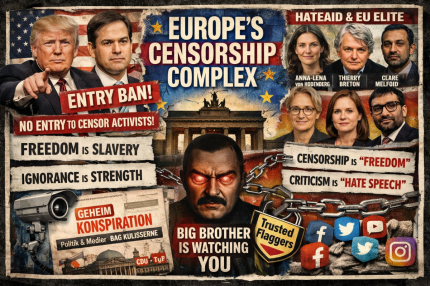
Last week, the Trump administration and Secretary of State Marco Rubio’s entry ban on Europe’s censorship–industrial complex was condemned by those in power and their state-funded media.
“Today, the State Department will take steps to prevent leading figures in the global censorship–industrial complex from entering the United States. We are ready and willing to expand this list if others do not change course,” U.S. Secretary of State Marco Rubio stated last week, when the American government imposed travel bans on five radical censorship activists: Anna-Lena von Hodenberg and Josephine Ballon of the German censorship organisation HateAid; the former EU Commissioner and architect of the EU’s Digital Services Act, Thierry Breton; the founder of the British Global Disinformation Index, Clare Melford; and Imran Ahmed of the UK-based Center for Countering Digital Hate.
According to Rubio and the U.S. State Department, these individuals represent “a censorship authority” that “regularly demands access to company-owned data from social-media platforms” in order “to intensify censorship.”
The five censorship activists are therefore unwelcome in the United States because, according to Marco Rubio, they represent organisations and European governments that abuse an alleged threat of “misinformation” as a pretext for restricting freedom of expression.
Both President Trump and Vice President J.D. Vance had previously criticised undemocratic interference in elections and in free speech on the old continent, so Europeans had been warned. Yet their censorship–industrial complex has simply ground on.
The European Commission, European heads of government, and their state-funded media naturally condemn the American visa ban. France’s President Macron speaks of “coercion and intimidation”; Denmark’s TV2 and a professor of “cybersecurity” at Aalborg University describe the American defence of free speech as “ominous.” But in a thorough and revealing article in the independent German outlet NIUS, journalist Pauline Voss uncovers close ties between the established political power parties (CDU, CSU, SPD, the Greens, Die Linke) and Germany’s censorship–industrial complex, which works systematically to curtail and restrict citizens’ freedom of expression—especially on social media. According to Voss, state-supported organisations such as HateAid actively promote political censorship and secure their gatekeeper role by entrenching an almost Orwellian narrative in the public sphere. HateAid has thus established itself as an unofficial censorship authority in the German media mainstream through the repetition and elevation of three simple propaganda falsehoods:
-
Censorship is “freedom of speech.”
-
Freedom of speech without censorship is “hate speech.”
-
The fight against censorship is “an attack on freedom of speech.”
Marco Rubio and the Trump administration’s visa ban therefore put their finger on a real and serious problem for freedom in the West and in Europe.
In these years, a dangerous shift is taking place in the European debate on freedom of expression. Organisations such as HateAid and the Center for Countering Digital Hate work actively to limit citizens’ speech, yet they are presented in state-funded media and in public debate not as a problem for democracy—but as its guardians. One of the clearest examples is the German organisation HateAid, which presents itself as a fighter against “online hate.” That sounds immediately sympathetic. But behind the pleasant language lies a systematic redefinition of freedom of expression: censorship is portrayed as protection, criticism is labelled hate, and the right to speak one’s mind is described as a threat to democracy. The organisation’s leadership has openly declared that freedom of expression “needs limits,” and that these limits need not follow the clear boundaries of criminal law. On the contrary, they argue for intervention even below the threshold of illegality—against expressions that are lawful, but politically or emotionally undesirable.
This constitutes a fundamental breach with democracy and the principles of the rule of law.
State-Funded Political Censorship Activism
HateAid receives millions in public funds and maintains close ties to left-wing parties and politicians. The organisation provides legal assistance to politicians who take citizens to court over sharp, satirical, or coarse expressions. At the same time, those very parties have been responsible for granting financial support to the organisation.
This creates obvious conflicts of interest. When the state finances private organisations that help those in power prosecute their critics, the boundary between democratic governance and political intimidation is blurred.
“Trusted Flaggers” and Private Censorship
With the EU’s Digital Services Act, this development has been institutionalised. Organisations such as HateAid have been designated so-called “Trusted Flaggers,” meaning that their reports of content must be given special priority by social-media platforms.
In practice, this creates pressure on platforms to delete too much rather than too little—even when the content is lawful. The result is censorship, self-censorship, lack of transparency, and citizens who lose their voice without explanation.
When concepts such as “hate,” “harmful speech,” and “negative impacts on democratic debate” are used without clear legal definitions, control over expression is shifted from courts to politically steered organisations.
A Democratic Paradox
Most troubling of all is that this is all done in the name of democracy. Restrictions on freedom of expression are presented as necessary to protect democracy from its enemies. But a democracy that cannot tolerate criticism—even sharp, provocative, or foolish criticism—has already lost its self-confidence. What is most alarming for Europeans right now is that the defence of their freedom of expression on social media has been abandoned and is being directly opposed by Europe’s political elite and their state-funded media. Must it now, apparently, come from America?
History shows that it is always those in power who define “what is acceptable” once boundaries are loosened. That is precisely why freedom of expression is meant as a protection against the state—not as a gift that can be withdrawn when it becomes uncomfortable.
The question is therefore simple: Who should have the final word? The citizens—or the organisations appointed by the state to speak on behalf of democracy?
If the answer is no longer the citizens, then we have a serious problem.
Then we are on the road to George Orwell’s Big Brother state:
Freedom is Slavery. Ignorance is Strength.