
It follows from the very nature of sovereignty that any state has the right to decide for itself who is allowed to cross its borders. If a country cannot define and defend its physical borders, it ultimately ceases to function as a country.
For that reason, it matters who is let in – and who is kept out. These are never neutral decisions. And in recent years, the United Kingdom appears to be moving in a troubling direction, one worth paying close attention to.
Elasticity Without Limits
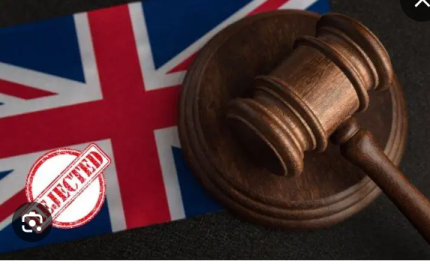
When British authorities deny individuals entry, it is typically on the grounds that their presence is not “conducive to the public good”.
At first glance, this sounds reasonable. In practice, however, the concept is highly elastic. It functions not merely as a legal tool, but as a political filter, often applied without a clear or specific justification.
This is not limited to historical cases such as the refusal of entry to the Dutch politician Geert Wilders in 2009. More recent examples point in the same direction. The Dutch commentator Eva Vlaardingerbroek and the American activist Valentina Gomez are among those who, in 2026, have had their travel authorisations revoked or have been turned away at the border.
What they have in common is not that they pose a terrorist threat, or that they incite or threaten violence, but that they express strong criticism of Islam – and, in particular, of the consequences of Islamisation.
To be fair, this tool is not used exclusively against political commentators. In 2026, the American imam Shadee Elmasry was denied entry after publicly defending Hamas. But the measure is no longer confined to Islamist agitators. Increasingly, it is being applied to individuals who are simply participating in public debate.
The Danish Contrast
The contrast with Denmark is striking. Here, the Danish Ministry of Immigration and Integration maintains an official list of foreign preachers who are denied entry.
The list is public.
The criteria are politically defined.
And the target group is clear: religious preachers who incite hatred, violence, or the undermining of democratic values.
That is a crucial difference. Not necessarily in outcome – but in principle.
Pressure That Changes the Rules
The United Kingdom is already under significant demographic and economic pressure. Every day, illegal migrants – primarily young men from the Middle East and Africa – cross the English Channel in small boats. In most cases, they are not returned. This places growing strain on the asylum system, the housing market, and local authorities, while fuelling an increasingly intense political conflict over migration, integration, and, not least, culture.
At the same time, the Muslim share of the population is growing to the point where it now constitutes a significant political force.
This forms part of the context in which the boundaries of what is considered legitimate criticism may begin to shift. And there are signs that this is precisely what is happening.
It is a predictable political response to attempt to reduce tensions – not only through legislation, but also by limiting certain voices in the public sphere through entry bans.
And when such bans increasingly affect individuals whose primary role is participation in public debate, a fundamental question arises:
When does a political opinion become a security risk? And who decides?
A Political Context
This development is unfolding within a political landscape where Keir Starmer and the Labour Party are under pressure from new voter groups. In the most recent general election, Labour lost votes in several constituencies to independent Muslim candidates with a clear Islamic agenda and strong appeal among Muslim voters.
This does not in itself prove that entry policy is directly driven by electoral considerations. But it is undoubtedly part of the context in which decisions are made – and very likely a contributing factor to the shifting threshold of what is deemed unacceptable.
When the Mirror Is Removed
No one has an automatic right to enter a country. But it says something about a society whom it chooses to exclude.
When peaceful commentators are turned away at the border while the criteria remain opaque, it is difficult to avoid the conclusion that this is not only about security, but also about excluding certain perspectives.
At the same time as the gradual move to deny entry to critics of Islam, the United Kingdom has in recent years developed traits resembling a surveillance society, where approximately 12,000 individuals annually come under police scrutiny for otherwise lawful expressions on social media. Today, the UK stands out as the Western country facing the most serious challenges to freedom of expression.
Taken together, this paints a picture of a society under increasing pressure – socially, economically, and culturally – where the temptation is not merely to counter criticism, but to contain it.
Including by keeping out those who articulate it most clearly.