
“Medieval Islam was a religion of remarkable tolerance for its time… Islam is part of our past and our present… It has helped to create modern Europe. It is part of our own inheritance, not a thing apart.”
The quotation dates back to 1993, when the then Prince of Wales – Britain’s present King Charles – delivered a speech at the Oxford Centre for Islamic Studies.
The remark was not incidental, but an expression of a fundamental outlook he has maintained ever since – and which today shapes his conduct as king.
His silence at Easter is therefore no trivial matter, but a direct consequence of that mindset.
King Charles has previously chosen to issue Easter messages and mark the occasion publicly. That is precisely why it becomes a political signal when he chooses not to do so this year – while, in February, finding it appropriate to address the country’s Muslims in connection with the end of Ramadan.
And in the situation Britain now finds itself in, this is not an omission.
It is a prioritisation.
The Disappearing Foundation
Britain’s king is not a private individual with spiritual interests. He is the bearer of an institution grounded in a specific historical and religious foundation. The British Crown is inseparably linked to Christianity – not as a loose cultural reference, but as a constitutional and civilisational foundation.
When the King chooses not to mark Easter, while earlier in the year addressing Muslims in connection with Ramadan, this is not a matter of scheduling.
It is a signal.
A signal of what is elevated – and what is being downplayed.
A society can accommodate many religions – but it cannot exist without a foundation.
When that foundation is relativised and reduced to one among many, it begins to disappear.
A One-Sided Orientation
Charles’s relationship with Islam is not characterized by sober analysis, but by a persistent romanticisation. As early as 1993, he portrayed Islam as a civilisational force behind Europe’s development.
At best, this is profoundly out of proportion.
For while the positive narrative is repeated, the conflicts in which Islam has historically and presently been involved in Europe are overlooked. The political dimension, the cultural tensions, and the concrete challenges facing Britain today are pushed into the background.
What remains is a selective and idealised understanding.
When this understanding is combined with a systematic downplaying of Christianity, the result is not balance but displacement – and that displacement may prove fatal.
A Country in Accelerating Change
Britain is not undergoing a stable transition. It is undergoing an acceleration: demographic change is rapid and increasingly skewed, religious identity is becoming ever more central for a growing segment of the population with a Muslim background, and political conflicts are increasingly organised along these lines.
We saw a striking example of this just weeks ago, when thousands of Muslim men gathered for communal prayer in Trafalgar Square – in the heart of historic London. A demonstrative display not merely of faith, but of presence, scale, and strength.
In itself, it is not unlawful.
But it is a powerful signal.
And at a time when such signals are becoming increasingly visible, it becomes decisive how the state’s highest symbol chooses to respond.
The King does not.
On the contrary, he contributes to the very erosion he ought to resist.
When Cultural Institutions Abandon Their Responsibility
Civilisations do not collapse overnight. They collapse when the institutions meant to sustain them begin to lose confidence in their own legitimacy.
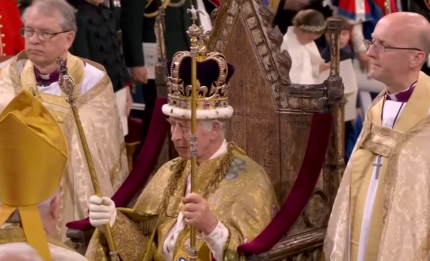
When the King no longer acts as the defender of the tradition he is entrusted to uphold, the signal extends far beyond the monarchy itself. He sent such a signal clearly at his coronation, when he declared that he would not be “Defender of the Faith” (Fidei Defensor), but rather “Defender of Faith” – not the defender of the faith, Christianity, but of faith in the broadest possible sense.
This tells the public that the common foundation is negotiable.
That history no longer obliges.
That continuity has been replaced by relativism.
And when this happens in a society already under strain, the process accelerates.
A Failure with Consequences
Charles’s silence at Easter is therefore not an isolated misjudgement. It is the result of a longer development – and a contribution to it.
From foundation to dissolution.
From continuity to relativism.
From civilisational confidence to civilisational doubt.
The question is not what the King intends to signal.
The question is what happens to a society when its highest symbol no longer defends the foundation upon which it rests.