
A growing sense of declining free speech
According to a survey published in 2025, only 46 per cent of Germans believe that people in Germany are free to express their political views. As recently as 1990, 78 per cent agreed with that statement.
Are J.D. Vance and the Trump administration right to criticise Germany and Europe for suppressing free speech?
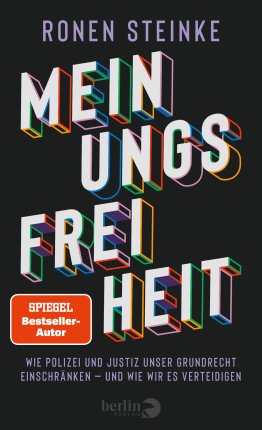
To a considerable extent, yes. That is the view of German lawyer and journalist Ronen Steinke, who in February 2026 published the book Free Speech: How Police and the Justice System Are Restricting Our Fundamental Rights – and How We Can Defend Them.
A critique from within the mainstream
While Steinke’s proposals for defending free speech remain vague and lack concrete policy solutions, the book is nonetheless significant. It demonstrates that restrictions on free speech in Germany are now being openly recognised and debated as a problem – even within the centre-left media mainstream.
Steinke is legal editor at the centre-left newspaper Süddeutsche Zeitung and teaches criminal law at a university in Frankfurt. Although he has not personally been subjected to censorship or legal sanctions, he argues that the criminal prosecution of speech in Germany has gone too far and now threatens the country’s democratic culture.
“The German state today defines a number of statements as criminal which, only ten years ago, clearly fell within the bounds of free speech,” Steinke writes.
Criminalising speech: a sharp rise in prosecutions
Steinke points in particular to the stricter enforcement of Section 188 of the German Criminal Code, which criminalises insults directed at politicians. This has led to a dramatic increase in prosecutions.
In 2021, prosecutors in the German federal states reportedly brought 748 such cases. By 2024, that number had risen to 4,439.
In what became known as the “Schwachkopf affair” in 2024, a pensioner named Stefan Niehoff was arrested—not for revealing state secrets, but for calling the then Green Economy Minister Robert Habeck an “idiot”. In 2025, criminal police opened a case against another pensioner who had violated Section 188 by committing the “serious offence” of calling Chancellor Friedrich Merz “Pinocchio” on social media.
“This is disproportionate,” Steinke writes, criticising German politicians for being overly thin-skinned and for using legislation to restrict free speech.
Expanding legal interpretations
Steinke criticises not only legislators for tightening criminal law, but also the increasingly expansive interpretation of these laws by police and the judiciary.
Courts now exercise broad discretion in classifying statements as incitement to violence or hatred that is “capable of disturbing public peace” (Section 130(1) of the German Criminal Code). According to Steinke, the number of such cases has “exploded since 2014”.
Cases concerning the approval of criminal acts (Section 140) have allegedly “increased a hundredfold”, not least because expressions approving of entirely fictional crimes are now being sanctioned—even when no actual offence has taken place.
Blasphemy laws and the limits of criticism
Steinke also regards the enforcement of Germany’s “blasphemy provision” (Section 166) as undemocratic and highly problematic, as it effectively criminalises criticism of Islam. Such criticism is frequently deemed by German authorities to be “capable of disturbing public order”.
In practice, this amounts to what is often described as a “heckler’s veto”, whereby the threat of offence or unrest is used to suppress legitimate criticism.
The threat of regulating “misinformation”
Finally, Steinke warns against European efforts to criminalise so-called “misinformation”. He identifies such tendencies in the governing agreement between Germany’s SPD and CDU, which calls for strengthened media oversight to combat “disinformation”.
He draws a parallel to former Danish minister Søren Pind’s proposal for a media ombudsman. From here, Steinke argues, it is only a short step towards a state “Ministry of Truth” and further restrictions on free speech.
An important but incomplete analysis
All in all, Steinke’s book is a highly relevant contribution to understanding the current crisis of free speech in Germany and Europe.
It is fair, however, to criticise the book for its lack of a deeper causal analysis. Why is free speech being restricted so sharply in Europe at this particular moment?
Steinke largely sidesteps several key aspects of the issue: the debate over banning opposition parties in Germany, the politically appointed Constitutional Court, and the role of the domestic intelligence service in shaping public discourse.
He also shows little interest in the fact that restrictions on free speech are not imposed solely by the state. Media institutions and civil society actors play an active role as well. This is particularly concerning where the state, through funding compliant NGOs, effectively circumvents constitutional limits on state interference in opinion formation—thereby restricting free speech more efficiently than if it relied solely on police and the courts.
A shifting consensus
Despite these shortcomings, Steinke’s book is important because it shows that restrictions on free speech in Germany are finally being recognised as a serious democratic problem—at least within parts of the political elite and segments of the publicly funded media mainstream.
Ronen Steinke: Meinungsfreiheit – Wie Polizei und Justiz unser Grundrecht einschränken – und wie wir es verteidigen, Berlin Verlag, 2026