
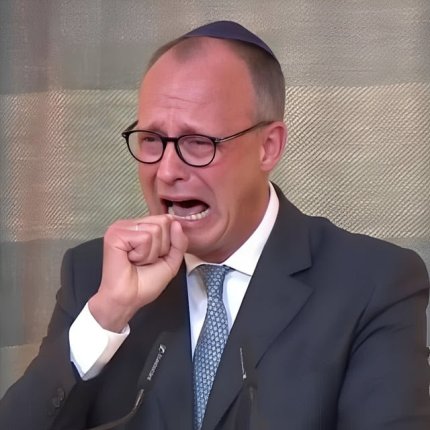
In a recent interview with the news magazine Der Spiegel, Chancellor Friedrich Merz (CDU) lamented that he is subjected to criticism and insults from citizens on social media:
“No chancellor before me has had to endure anything like this,” he complained—thereby revealing a strikingly undemocratic intolerance of the public’s right to criticise those in power.
The remark is all the more notable given that Merz himself has, in the past, pursued thousands of criminal complaints against what he regarded as insulting remarks made by citizens and political opponents.
During his time as opposition leader, Merz initiated legal action against several thousand citizens for alleged insults directed at politicians, using the private claims enforcement company “So Done”. In total, he is reported to have personally signed 4,999 criminal complaints. According to Welt am Sonntag, the company retained half of the compensation payments collected, while Merz himself claims to have donated his share in full to charitable causes in his home region.
Welt am Sonntag also uncovered previously unknown cases of police searches carried out as a consequence of these complaints. In one instance, police confiscated the mobile phone of a disabled welfare recipient who had allegedly referred to Merz as “a little Nazi”. In another case, a district court in Stuttgart ordered a house search against a man who had called Merz a “drunkard” on the social media platform X.
The Higher Regional Court in Stuttgart later ruled that this was unlawful under Section 188 of the German Criminal Code, which criminalises “insult, defamation, and slander against persons in political life”.
It was the CDU–SPD government under Chancellor Angela Merkel that tightened Section 188 in 2021—according to its own justification, in order to more effectively combat “targeted smear campaigns” against politicians.
Following a police search of a pensioner in November 2024—after he had called the then Federal Minister for Economic Affairs, Robert Habeck (The Greens), an “idiot”—several politicians criticised Section 188. Both the Alternative for Germany (AfD) and the Free Democratic Party (FDP) have called for its abolition.
Nevertheless, “So Done”, led by a former youth leader of the FDP, has represented several FDP politicians, including Member of the European Parliament Marie-Agnes Strack-Zimmermann.
Chancellor Merz’s intolerance of public criticism, combined with his heavy-handed interventions against free expression on social media, has led journalist Pauline Voss (NIUS) to question whether Germany’s Chancellor truly understands what democracy entails.
And, paraphrasing Bertolt Brecht’s satirical poem about the 1953 uprising in East Germany, she offers the Chancellor a solution:
Perhaps the Chancellor should choose himself a new people.