
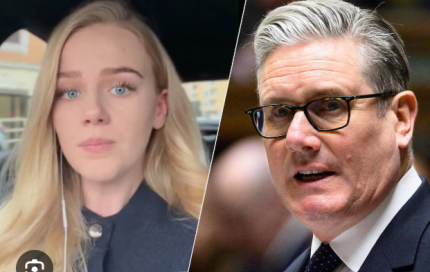
Last week, the Dutch lawyer and commentator Eva Vlaardingerbroek published a remarkable message from the British authorities: she is no longer welcome in the United Kingdom because her presence is deemed “not conducive to the public good.” According to Vlaardingerbroek herself, the decision came exactly three days after she had criticised Prime Minister Keir Starmer on X.
Formally, there is nothing controversial about this. Every sovereign state has the right to decide whom it admits. This also applies to the United Kingdom. Immigration control is the state’s last and most fundamental instrument of power. There is no human right to enter another country.
But that is precisely why the question becomes politically explosive: whom does the state choose to use this power against — and when?
Vlaardingerbroek is not a violent actor. She is not an organiser of illegal activities. She is not an Islamist, a jihadist or a revolutionary, but on the contrary an outspoken democrat and a supporter of the rule of law. And she is a sharp and increasingly influential Islam-critical voice. She spoke, among other things, at Tommy Robinson’s Unite the Kingdom demonstration in September, followed by millions in the streets of London and online, and she has never called for violence, for extra-parliamentary revolt, or for breaking the rules of democratic government.
Yet she is now shut out.
This is not the first time Britain has played the entry-ban card against Islam-critical figures. In 2009, the Dutch politician Geert Wilders was denied entry when he was on his way to London to screen his Islam-critical film Fitna. He was taken off the plane at Heathrow and sent straight back, with exactly the same justification: not “conducive to the public good”. A British court later overturned the decision. But the pattern had been established.
And it did not end there. In 2013, the American author and Islam critic Robert Spencer was denied entry to Britain when he was due to speak at a peaceful demonstration after the murder of a British soldier in Woolwich. Once again, the authorities invoked the same formula: his presence was not “conducive to the public good”.
Three names.
Three entry bans.
The same justification.
At the same time, Britain for decades welcomed Islamist preachers and radical ideologues who openly preached anti-democratic doctrines, religious supremacy and hatred of the West in general — and of the country that had taken them in in particular. Anjem Choudary and Omar Bakri are merely the best-known examples of figures who were allowed to operate freely for years before the authorities finally intervened. They held meetings. They built networks. They radicalised young men.
But Eva Vlaardingerbroek — a European lawyer who speaks about integration, Islam and national identity — is suddenly declared a threat to “the public good”.
That says something about priorities.
Britain today finds itself in a condition that successive governments refuse to describe honestly: a society under structural pressure from massive, uncontrolled migration, especially of young men from the Middle East, Africa and South Asia. Last year alone, more than 41,000 people crossed the English Channel in small boats. The vast majority are allowed to stay. The asylum system has long since broken down — and integration with it.
The three largest English cities — London, Birmingham and Manchester — are now led by Muslim mayors. An electoral manifestation of exploding parallel societies marked by religious exceptionalism, violence, clan structures and a healthcare system on the verge of collapse.
Trust in politicians and public authorities is at rock bottom, and free speech is under heavy pressure: more than 12,000 people were arrested or prosecuted in 2023 alone for speech-related offences, primarily on social media. Tommy Robinson is imprisoned again and again — while his audience keeps growing.
And in the middle of this landscape, Keir Starmer’s government chooses to use the state’s sovereign power of entry control against a Dutch commentator whose primary “crime” is that she holds up a mirror to developments in England.
This is where the Vlaardingerbroek case becomes more than a single incident. It becomes a symptom.
For it is striking that the country in Europe which today is closest to civil-war-like tensions as a direct consequence of massive importation of Islam — time and again denies entry precisely to those who sound the alarm.
One does not silence jihadists in time.
One does not secure the borders effectively.
One does not close the loopholes in the asylum system.
But one closes the door to critics.
Legally, Britain is within its rights. It is difficult to dispute that a sovereign state decides who may enter and who may be turned away. Politically, however, the decision is a self-inflicted wound.
For what does it say about a liberal democracy when the state uses border control to filter opinions instead of confronting realities? When “the public good” suddenly comes to mean the absence of uncomfortable voices — rather than the solution to the very real problems that millions of people experience in their daily lives?
If Keir Starmer believes that one can halt public anger, the integration crisis and social fragmentation by denying entry to Eva Vlaardingerbroek, he is repeating exactly the mistake that led to both the Wilders and Robert Spencer cases.
And to Britain’s present situation.
One can forbid people to enter.
One cannot forbid reality from emerging.