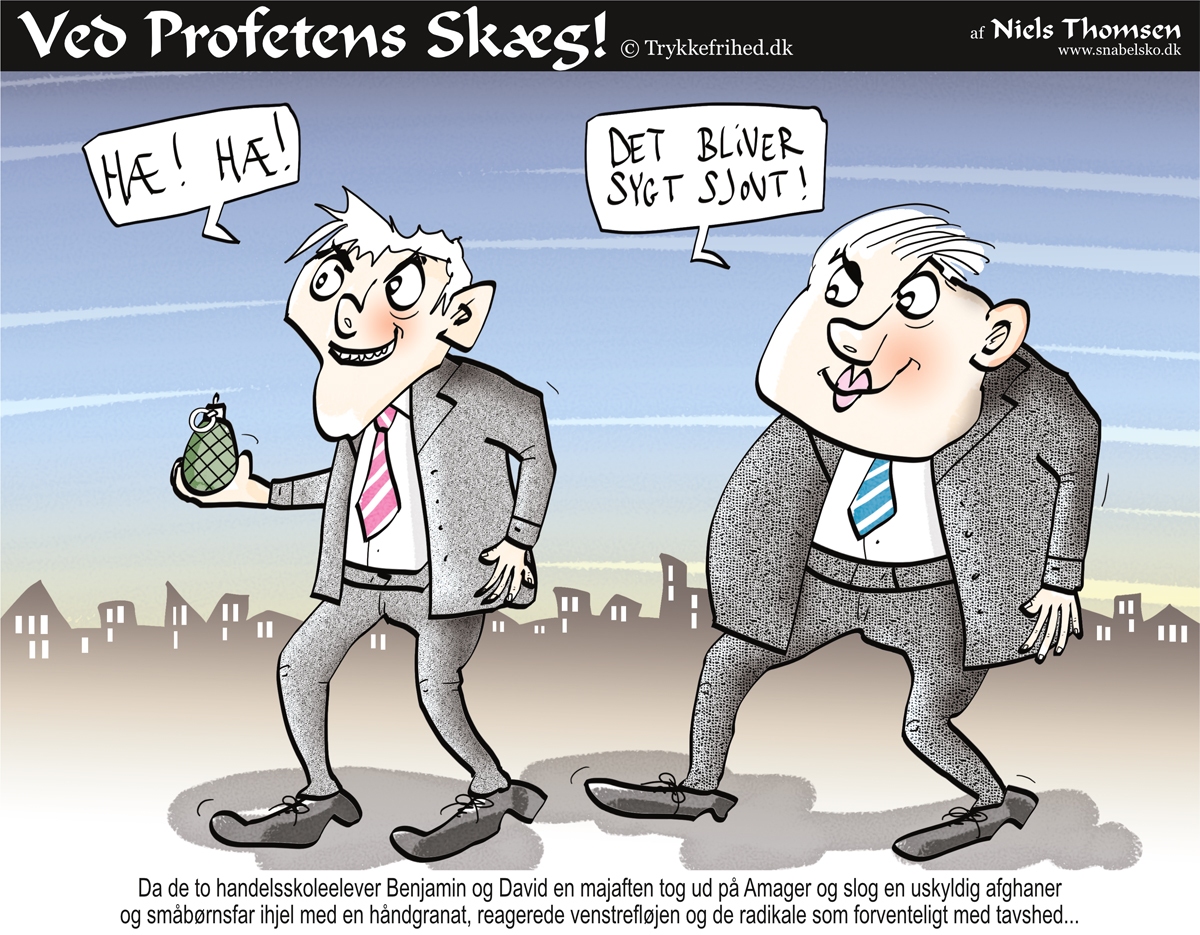

When it comes to the protests in Iran and the clerical regime’s barbaric slaughter of thousands of unarmed civilians, the Danish left has been strikingly silent. Not just silent — but selectively silent. Not as in Gaza. Not with daily breaking news, emotional reports and moral sermons from state-funded media and activist commentators who are otherwise quick to act when a conflict can be fitted into the right ideological frame.
Like DR’s inadequate coverage of Iran, this silence is not accidental. It is ideological. When the victims cannot be used to confirm the narrative of the West as the villain and Islamism as misunderstood resistance, the indignation evaporates.
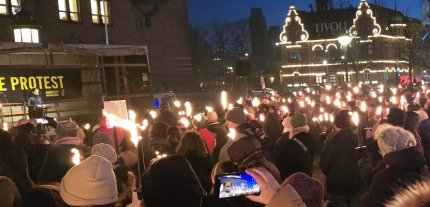
That is why it initially seemed encouraging when Amnesty International called for a demonstration on 19 January at 5 p.m. on City Hall Square:
“Torchlight vigil: Protect the demonstrators in Iran.
Brave people are taking to the streets in Iran. They are risking their lives for their freedom and basic human rights.
The regime has responded with killings, mass arrests and an internet shutdown.
Come and show the brave demonstrators our solidarity and support.”
At last, it sounded as if the left — and its permanent NGO satellites — had woken up.
The Danish Free Press Society therefore took part in the positive expectation that this would be a genuine solidarity demonstration with the Iranians and their struggle for the سقوط of the clerical regime. That this time the focus would not merely be on the right to demonstrate, but on the right to break free from a despotic, theocratic system.
It was not.
It turned out to be something very different.
A Fig Leaf — and a Choreographed Demonstration
Ahead of the demonstration, a ban had been imposed on flags, which in itself was reasonable enough given that torches were being distributed. But there was also a ban on a range of expressions: no racism, no party-political flags, no banners.
In practice, this meant: no political statements that did not fit into the organisers’ ideological framework.
Even so, many wrapped themselves in the Iranian lion flag, and several Israeli flags also appeared. Many Iranian exiles had shown up. Many torches were lit. The atmosphere was intense, dignified and grave — exactly as the situation in Iran demands.
When the demonstration began at 5 p.m. with the first speech by Vibe Klarup from Amnesty International Denmark, it quickly became clear that this was not about supporting the Iranians in their struggle against the clerical regime and demanding its fall. It was about one thing only: supporting the Iranians’ right to protest without being killed.
There is a great difference.
The one is a minimal human-rights position. The other is an existential and political struggle for freedom. And Amnesty had chosen the first — the harmless, non-confrontational, non-system-critical version that fits neatly into the sterile comfort zone of NGO rhetoric, but which is utterly inadequate when confronting a regime that shoots demonstrators in the streets.
From Solidarity to Red–Green Rhetoric
As the speeches continued and poems were read aloud, we — and many others — became increasingly uneasy about what it was we had actually walked into. The unease culminated when Mehrak Lykkeberg Salimi went all in on pure Red–Green Alliance rhetoric.
She warned against any external intervention — from Israel or the United States. This was the Iranians’ own struggle, she said, and they should be allowed to fight it themselves. Without weapons. Against the security forces of a militarised clerical regime that has so far slaughtered up to 20,000 civilians in the streets.
It was at this point that many began to shout “Pahlavi!” and “Javid Shah!” — entirely legitimate political expressions at a demonstration that was supposedly about Iranian freedom.
The organisers reacted immediately. They asked the demonstrators to remain silent, referring to the rule that there must be no political statements. When many continued, a voice from the stage shouted:
“Will you please stop?!”
So much for pluralism.
The Unforgivable Betrayal
Everyone knows — Amnesty included — that a decisive reason why Iranians now dare to take to the streets at the risk of their lives is that they have been promised support from both Israel and the United States. This is not something the West has invented. It is something the Iranians themselves say again and again, in interviews, on social media and in their cries to the outside world.
The Iranians are not asking for peaceful resolutions, dialogue seminars or yet another pile of human-rights reports gathering dust in the UN archives. They are begging the West to intervene and help them.
And then Mehrak Lykkeberg Salimi stands there and renounces precisely that help — on their behalf.
That is not just tone-deaf. It is not just naïve. It is physically undermining a freedom struggle that is unfolding in real time, with dead bodies in the streets and prisons filled with young men and women whose only crime is that they want to live without Islamic tyranny.
It was unbearable.
We booed.
We extinguished our torches.
And we left
Amnesty’s Fig Leaf
Amnesty’s demonstration was a fig leaf designed to avoid lifting a finger for the Iranians, because doing so would require admitting that Islam is a despotic, misogynistic system of ideological coercion. And that the left neither will nor can admit, because their entire worldview rests on that error.
On that account, the demonstrators were burdened with so many injunctions and restrictions that they were in practice reduced to extras in Amnesty’s choreography — an emotionally aesthetic arrangement without criticism of the Islamism that is the very raison d’être of the clerical dictatorship, without realism and without respect for what the Iranians themselves are asking for.
It was not a democratic demonstration.
“No party-political flags” meant de facto: no expressions of support for those who are actually willing to defend Iran — and criticise Islam.
One does not take seriously what the Iranians themselves want. One claims to celebrate pluralism, but practises the opposite: that all views other than the organisers’ own are told to keep quiet.
This was not solidarity.
It was ideological staging.
And it was a profound betrayal of the Iranian people’s struggle for freedom.