
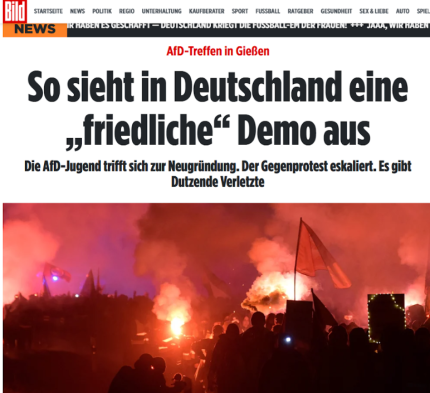
Last weekend, far-left extremists in Germany attempted to prevent the youth congress of the AfD in Giessen through street violence and assaults on political opponents. What unfolded was a direct, brutal attack on freedom of speech and assembly: AfD politicians and independent journalists were assaulted, red-clad street militants hunted down conference attendees, roads were blocked, property vandalised, and thirty police officers injured. The Interior Minister of Hesse described the situation as “akin to civil war.” The police union condemned the events as “a hideous face of left-wing extremism,” strongly rejecting the attempts by state-funded media to portray the weekend’s unrest as “mostly peaceful.” AfD leader Alice Weidel called the violence “deeply undemocratic.”
The unrest in Giessen was an anti-democratic campaign of violence aimed squarely at crushing freedom of expression and assembly—reminiscent of the worst years of the Weimar Republic. Yet state-funded media in Denmark virtually ignored the events—presumably because the violence came from the political left.
Danish Broadcasting Corporation (DR) simply portrayed the rampage of these red fascists as “demonstrations,” concealed the far-left violence, and even reversed the roles of victim and perpetrator. DR’s report framed the weekend’s left-wing violence as though the real victims were the far-left mobs themselves: “50,000 demonstrators fear newly established AfD youth wing,” the headline declared—an empathetic spin that focused on the supposed anxieties of the perpetrators rather than the victims who were exercising their democratic right to form a youth organisation for an opposition party.
It is telling to compare DR’s whitewashing of far-left attacks on freedom of expression in Germany with its manipulative attempt to portray Tommy Robinson’s peaceful “Unite the Kingdom” demonstration in London in September as violent. In DR’s coverage, the AfD’s attempt to establish a democratic youth wing was framed as suspicious, the party itself labelled “extremist,” while the far-left violence against freedom of expression and assembly in Germany was not labelled extremist at all—on the contrary, it was downplayed and sanitised. This journalistic double standard has marked DR’s political coverage for years, especially in Germany, where DR’s far-left journalist Steen Nørskov has repeatedly framed his reports in support of undemocratic efforts to pressure Germany’s constitutional court and intelligence services into banning the country’s largest democratic opposition party.
The Free Press Society has previously asked: which other democratic parties in Europe would DR and Steen Nørskov like to see outlawed?
DR’s biased coverage of far-left attacks on freedom of speech and assembly in Germany is comparable to a situation in which a taxpayer-funded media outlet downplayed the seriousness of violent far-right attacks on a democratic socialist party attempting to exercise its right of assembly to found a youth wing.
Even small independent media outlets are now criticising the way state-funded broadcasters and political leaders trivialise far-left anti-democratic violence in Germany.
The government claims it will investigate DR’s political bias. This is a delaying tactic and nothing will come of it. Why should the state still have the power to decide that certain media outlets must be financed through a special tax?
It is the equivalent of forcing every citizen to subscribe to the newspaper Politiken. A genuine reckoning with state-funded media is a prerequisite for real democratic development—both in Denmark and in Europe.