
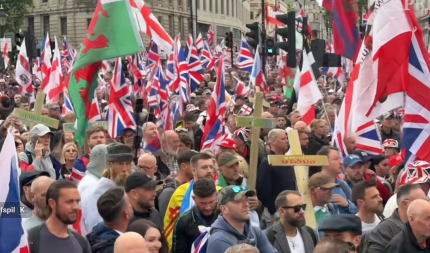
For the fifth time in less than two years, the Free Press Society took part on Saturday in Tommy Robinson’s Unite the Kingdom demonstration in London. And if one thing became clear after this latest demonstration, it is that the protest movement emerging in England is far larger, far more popular and far more civilisationally grounded than the media caricature of it allows.
But it also became clear that the movement is hitting a ceiling.
A Civilisational Manifestation
Once again, the demonstration drew enormous crowds. Central London was packed with people, and throughout the day it was difficult not to notice something almost never described in the media: the atmosphere. There was no revolutionary frenzy. No aggressive mass psychosis. Quite the opposite: it was patriotic, orderly and entirely peaceful. Patriotic songs were sung, there were speeches about Christianity, British culture and national cohesion, and Tommy Robinson opened the demonstration with a collective recitation of the Lord’s Prayer.
What we witnessed was not a revolutionary movement. It was a civilisational manifestation.
That is important to understand, because the media continues to portray Tommy Robinson and the people gathered around him as a fringe phenomenon made up of hooligans, extremists and angry marginalised men. But that picture simply does not correspond to the reality on the streets.
England’s Quiet Despair
Perhaps the most striking thing about the demonstration was precisely the absence of what the media constantly implies one should expect to encounter. There was no violence. No hateful masses. Quite the opposite. People stood for hours in the streets of London carrying flags, singing Christian hymns and listening to speeches about parliamentary democracy, the rule of law and national cohesion.
And perhaps that is precisely what makes the situation so deeply tragic.
Because it was difficult to escape the feeling that many of the people standing there did not see themselves as revolutionaries, but as people trying to hold on to something they feel is slipping away: the right to their culture, their historical continuity and, above all, the right to continue experiencing England as their home.
It is difficult not to see the tragedy in the fact that so many people who are primarily asking for the rule of law, cultural continuity and equal treatment are increasingly treated as suspect in their own country.
The Movement’s Glass Ceiling
Tommy Robinson is capable of mobilising the working class to an extent that no one else in England currently can. Not merely parts of it, but seemingly almost the entire traditional English working class. The demonstration was not simply a peaceful protest by those most directly affected by the rapid transformation of their country — it was a patriotic declaration of love for the national identity.
At the same time, however, it also became clear that the movement is colliding with a social and cultural ceiling. England remains an intensely class-divided society, and that reality is palpable everywhere around Tommy Robinson.
There were middle-class participants at the demonstration, but many concealed themselves. Perhaps because Keir Starmer had ordered the deployment of facial-recognition cameras: hats and sunglasses were strikingly common. Among others, we spoke to a woman who told us she had previously lost her job after expressing her views publicly. That was why she concealed her face.
Perhaps that is one of the most remarkable aspects of present-day England.
Recent local elections show that many beyond the working class clearly share the analysis privately, yet do not wish to be associated with Tommy Robinson or the working-class protest he represents. Not necessarily because they disagree with the message, but because Tommy Robinson is still culturally and socially perceived as “working class” in the most English and traditional sense of the term. Too rough. Too direct. Insufficiently respectable.
That is where the movement reaches its glass ceiling.
Protest Without Representation
It was therefore particularly striking that neither Nigel Farage nor Rupert Lowe wished to speak at the demonstration, even though many of those attending were undoubtedly their own voters. They are willing to represent the frustration in Parliament, but they do not wish to identify themselves too closely with the popular protest driving it.
The only major political figure who actually addressed the demonstration was Ben Habib of Advance UK.
That too says something about England.
The Homeless Protest
Perhaps the most striking aspect of the demonstration was precisely the tension between the enormous popular force of the protest and its near-total lack of institutional and cultural representation. The protest exists. It is growing explosively. Yet large sections of the British elite continue to behave as though it either does not exist or ought to be socially and politically isolated.
At the same time, it is worth noting how little of the movement is genuinely revolutionary. Tommy Robinson devoted much of his speech to encouraging people to vote: two million Britons do not vote in parliamentary elections, and he repeatedly stressed the importance of democratic participation. The point was not the party, but participation itself. Parliamentarianism. The need for ordinary people once again to signal to politicians that the direction England is taking cannot continue unchanged.
It is very difficult to detect extremism in a collective Lord’s Prayer and an appeal for democratic participation.
Yet perhaps that is precisely why the movement is so difficult for both the media and the political class to handle. Because if the protest can no longer be dismissed as hooliganism and fringe extremism, then one is forced to confront the question an increasing number of Britons are now asking.
A Question England Does Not Want to Hear
What happens to a society when large parts of the population lose trust in its institutions while simultaneously experiencing that no one with real power wishes to speak honestly about the causes?
That is the real story in England today.
And perhaps the most tragic aspect of all is this: that a protest movement fundamentally concerned with the rule of law, parliamentary democracy, cultural continuity and the desire to continue feeling at home in one’s own country has itself become socially and culturally homeless.
That is a dangerous development for any society.