
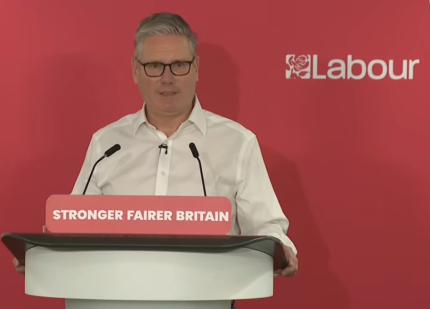
“We will block far right agitators from traveling to Britain this weekend for a march designed to confront and provoke our diverse capital city. We will not allow people to come to the UK, threaten our communities and spread hate on our streets.”
That was Keir Starmer’s response this week to the rapidly expanding Unite the Kingdom demonstrations in London.
What is striking is not merely the tone. What is striking is what is missing.
Even after Reform UK’s landslide election result and demonstrations that now draw hundreds of thousands of people into central London, the response from the political elite still seems, above all, to consist of more censorship and more control over the voices and movements expressing public discontent. Not a genuine confrontation with the causes of the growing distrust, but an increasing fixation on the people articulating it — accompanied by an unmistakable willingness to silence them.
In the eyes of Starmer and Labour, the protest itself has become the problem.
The Protest the Media Refuses to See
At the end of this week, the Free Press Society will once again travel to London to participate in Tommy Robinson’s Unite the Kingdom demonstration. It will be the fifth time in less than two years that we have gone there to witness, firsthand, a protest movement growing at a pace and on a scale that ought to dominate any serious coverage of Britain.
The first demonstration, in the summer of 2024, gathered around 30,000 people. The latest filled central London with several hundred thousand participants while millions followed the livestream on social media. And all indications suggest that Saturday’s demonstration may be even larger still. Yet the demonstrations continue to be treated as a fringe phenomenon — or ignored entirely — including by the Danish media.
At the same time, Reform UK has just delivered a political earthquake that much of the press insists on explaining away through economics, a collapsing healthcare system, inflation and ordinary voter frustration. But it is as though the media only describes the surface of something far deeper. They see the smoke, but not the fire.
The Smoke and the Fire
What is unfolding in England right now is not primarily about waiting lists, tax policy or the embarrassing appointment of Peter Mandelson as ambassador. It is about collapsing trust in politicians and in the institutions that were meant to hold society together. The demonstrations and Reform UK’s rise are two different expressions of the same underlying protest.
And the remarkable thing is not merely the size of the protest. The remarkable thing is how little both politicians and the media seem to understand it.
On the streets, people are not primarily talking about inflation. They are talking about unequal treatment. About a police force that reacts more quickly to social media posts than to the problems authorities have spent years avoiding. They talk about the grooming gang scandals, in which vulnerable young girls from disadvantaged backgrounds were systematically failed by police, councils and social services while institutional paralysis grew out of fear of accusations of racism or stigmatisation.
It is difficult to imagine anything more destructive to trust in the state.
“Two-Tiering”
The British themselves have a term for it: two-tiering. Unequal treatment. The growing perception that laws are no longer enforced equally. That some problems are handled with extreme caution, while critics of the system are treated increasingly harshly. Every year, British police record or visit thousands of people over social media posts and comments. Not because serious crimes have been committed, but because the state appears increasingly preoccupied with regulating the language surrounding the problems rather than confronting the problems themselves.
That is the development that makes the protest so serious.
Because once trust in institutions begins to erode, a vacuum opens between the reality people experience and the reality described by those in power. And the wider that gap becomes, the more explosive the protest will grow.
The Protest as the Problem
That is precisely why Keir Starmer’s response is so remarkable. Rather than addressing the underlying causes of the growing distrust, he merely adds more pressure to the boilers that have already turned England into a pressure cooker.
Meanwhile, the media — not only the British media, but certainly also the Danish press — remains trapped in explanatory models that appear hopelessly inadequate. Journalists such as Lone Theils, who has lived in Britain for years, still seem unable to grasp the depth of the institutional and cultural distrust spreading beneath the surface.
Either the media no longer understands the society it was created to describe. Or it has become so frightened by the implications of what it sees that it no longer dares to describe it honestly.
A Society Without Trust
Because this protest is not merely about politics. It is about legitimacy.
No society can function for long if large parts of the population lose trust both in institutions and in the way reality itself is described. No state governed by the rule of law can survive if citizens begin to experience the law as asymmetrically enforced. And no public sphere can function if the media reduces deep civilisational tensions to questions of economics and dissatisfied voters.
The remarkable thing about England, therefore, is not the protest alone.
The remarkable thing is how many people still pretend not to see what it is actually an expression of.
And that is what makes England a tinderbox.