

Some historians are met with scholarly disagreement. Others are met with something far more revealing: a desire that they simply should not be heard.
Raymond Ibrahim belongs to the latter category.
For more than two decades, the Coptic-American historian has written about one of the most sensitive and systematically underreported issues of our time: the persecution of Christians in large parts of the Muslim world — and the long historical background to the conflicts between Islam and Christendom that many Western academic environments prefer to reduce to “misunderstandings,” “socio-economic tensions,” or colonial aftershocks.
Ibrahim insists on something far more fundamental: that religion matters. That texts matter. That history matters. And that violence does not become less real simply because it is inconvenient.
That is precisely why he has become so controversial.
The Silence Surrounding the Persecution of Christians
At a time when human rights otherwise occupy a central place in Western self-understanding, it is striking how little attention is given to the situation of Christians in public debate.
Today, Christians are the most persecuted religious group in the world, and yet their situation is often treated as a marginal issue — something that can be politely acknowledged, but rarely discussed with the seriousness and consistency it deserves.
Raymond Ibrahim has made it his mission to document precisely this reality. His work focuses particularly on the conditions facing Christians in Muslim-majority countries, where they often live as vulnerable minorities, but also in other authoritarian contexts such as North Korea.
In 2011, Ibrahim began a monthly report series at the Gatestone Institute under the title Muslim Persecution of Christians. In these reports, he systematically collected and summarized documented cases of persecution of Christians from across the Muslim world, but also from China and North Korea.
The reports described murders, violent assaults, the burning of churches, vandalism against Christian property, legal discrimination through blasphemy and apostasy laws, as well as forced conversions and threats linked to religious identity.
The overall picture pointed not to sporadic incidents, but to chronic and structural persecution — and to a striking Western reluctance to speak clearly about it.
In many Muslim-majority countries, Christians are not merely exposed to random hostility, but to legal and cultural systems in which they are in practice tolerated as second-class citizens. Blasphemy legislation, punishments for apostasy, and institutionalized discrimination make it dangerous to be a Christian — and even more dangerous to leave Islam.
Ibrahim’s central argument is that this reality cannot be understood without taking religion’s normative texts seriously. When one refuses to do so, the persecution of Christians is reduced to sociology, even though it is often theology translated into power.
The Historical Roots of the Present — and Why They Are Unwelcome
Ibrahim does not limit himself to documenting present-day abuses. In books such as Crucified Again (2013) and Sword and Scimitar (2018), he seeks to place contemporary conflicts within a broader historical framework.
Here he draws on primary sources: medieval chronicles, legal texts, missionary reports, and eyewitness accounts. His fluent command of Arabic gives him direct access to classical Muslim source texts that are rarely incorporated into Western historiography.
He has also contributed to the understanding of modern jihadism. In The Al Qaeda Reader (2007), he compiled and translated key texts by al-Qaeda leaders such as Osama bin Laden and Ayman al-Zawahiri.
The work documented how jihadist movements legitimize violence through references to the Qur’an and the hadith — and how their rhetoric is deliberately adapted to different audiences.
Precisely because Ibrahim insists on the religious dimension of the conflict, attempts have been made to silence him.
On several occasions, Muslim advocacy organizations have sought to have his lectures cancelled at American educational institutions under accusations of “Islamophobia.”
A well-known example occurred in 2019, when Ibrahim was scheduled to speak at the U.S. Army War College. The event was cancelled after pressure from the Muslim organization CAIR and was only held later following massive public support.
This raises a fundamental question:
Is there still room in the West for scholars who investigate uncomfortable historical realities — especially when these clash with the dominant ideological comfort zone?
The Iran Parallel — and the Reason for the Sappho Prize
It is difficult not to see a parallel in the sluggish response of large parts of Western media and opinion-forming circles to the Iranian people’s uprising against clerical rule.
When millions of people in a theocratic regime demand freedom and rise up against religious oppression, it reveals something many would prefer to ignore: that religion can also be power, coercion, and violence — not only identity.
Raymond Ibrahim has spent his life breaking precisely this silence.
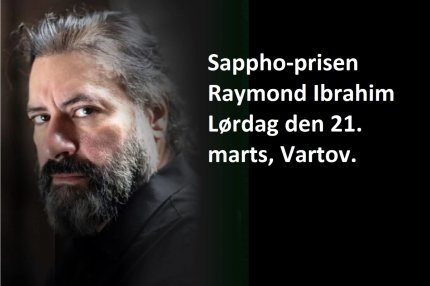
On 21 March 2026, Raymond Ibrahim will receive the Danish Free Press Society’s freedom of expression award, the Sappho Prize, in recognition of his source-based integrity and intellectual fearlessness in shedding light on both the persecution of Christians and the historical realities behind Islamist violence — despite sustained attempts to silence him.
Regardless of where one stands on his conclusions, his work should be read, discussed, and critically examined on scholarly grounds — not censored or delegitimized.
For Christians living under pressure around the world, this is not an academic debate. It is about visibility, truth, and the right to be taken seriously.
And for us in the West, the question is just as simple: Do we still have the courage to face reality when it does not fit our preferred narratives?
If there is no room for historians like Raymond Ibrahim — scholars who insist on sources rather than comfort — then it is not only the past we distort. We weaken the very freedom we claim to defend.