

The Signal of Silence
When the Coptic-American historian Raymond Ibrahim visited Copenhagen this weekend to receive the Danish Free Press Society’s free speech award, the Sappho Prize, it was in recognition of more than two decades of work documenting the systematic persecution of Christians in large parts of the world — a reality that continues to be met with a striking silence in Western public discourse.
Press releases were issued. Invitations were sent — including directly to all Danish bishops. No response followed. Not a single one found reason to attend. Not a single one found it relevant to acquaint themselves with a development that concerns, first and foremost, their fellow believers, but ultimately also the historical foundation of their own institution.
Silence can have many explanations. Busyness. Priorities. Coincidence.
But there are situations in which silence itself becomes a signal — where the absence of interest can no longer be explained away, but must be understood as a choice.
Man merkt die Absicht und wird verstimmt: Everything points to a clerical elite that is in the process of detaching itself from the civilisational experience upon which its office rests. A church that no longer feels obliged to understand or engage with the conditions of Christians in the world does not merely weaken its connection to its fellow believers. It weakens the very basis of its own legitimacy.
A Symbolic Scandal
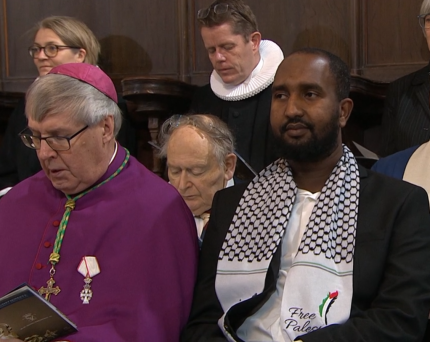
This development became almost symbolically visible during the service at Aarhus Cathedral in January 2024 marking the celebration of the new royal couple. On that occasion, an imam — a representative of the religion responsible for the majority of Christian persecution in large parts of the world — was invited to participate in a solemn church ceremony for the nation’s head of state.
Inviting such a representative into the very heart of a culture-bearing institution, without reflecting on the signal it sends, is in itself striking. That he chose to appear wearing a political Palestinian scarf bearing the words “Free Palestine” made the situation even more revealing. It was an affront. A demonstrative assertion of power.
What was most striking, however, was not the act itself, but the absence of any reaction: no one asked him to leave, no one distanced themselves — on the contrary, he was given a prominent place within the church.
Pre-emptive Capitulation
The German-Jewish writer Henryk M. Broder has described this mentality as pre-emptive capitulation: a condition in which one not only refrains from defending one’s own values, but abandons them in advance.
Islam is no longer a Trojan horse. No one today can be in doubt as to whom and what is being invited in. When this nonetheless takes place — and when even mockery is accepted as part of hospitality — it is not an expression of tolerance or generosity. It is a sign of cultural self-disarmament.
When the Foundation Weakens
Danish society — like the rest of Europe — is historically shaped by a Judeo-Christian framework of values and morality. Concepts such as human dignity, responsibility, and the limitation of power did not arise in a cultural vacuum. They emerged over centuries within a Christian civilisational context. When this foundation is relativised or ignored by those entrusted with its stewardship, the consequences extend far beyond the church itself.
And so we are left with a simple fact:
A historian who has devoted his life to documenting the persecution of Christians is invited to Denmark — and none of the country’s bishops find it worth attending.
One can scarcely imagine a more precise illustration of a church drifting away from its own historical role.
Civilisations rarely collapse because they are defeated from without.
They collapse because their own institutions cease to believe in what they were meant to defend.
Once the church loses faith in itself, the rest is only a matter of time.