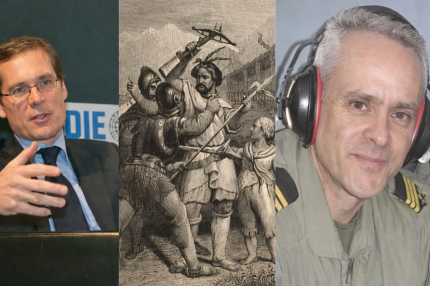
In Switzerland, the people have always rebelled against symbols of foreign power. A tyrannical bailiff of a foreign emperor in a multicultural empire once had his hat mounted on a pole in the town square in Altdorf. He then ordered the people of the canton of Uri to bow and humiliate themselves as a sign of their submission whenever they passed the bailiff Gessler’s hat on a stake. But Wilhelm Tell, a peaceful and upright man of the people, refused to bend the knee. He rose up against tyranny and foreign rule, and the Swiss followed him. “Even the most devout cannot live in peace if it does not suit the wicked neighbour,” Schiller has him say. The story of Switzerland’s freedom hero is a classic—and more актуal than ever:
In December, the EU placed Jacques Baud, a former colonel in the Swiss army and a strategic analyst, on its sanctions list. The charge: that Baud allegedly serves as a mouthpiece for pro-Russian propaganda and spreads conspiracy theories. For Baud, who now lives in Brussels, the sanctions have destroyed his life. His accounts are frozen and his economic existence lies in ruins.
The curtailment of Baud’s freedom of expression is a concrete example of the authoritarian policy toward dissidents and power-critical viewpoints that European Commission President Ursula von der Leyen announced in a speech in May 2024 in Copenhagen, where— in the reverent presence of Mette Frederiksen—she thundered against “misinformation” and compared her opponents’ freedom of expression to a disease that must be vaccinated against. No state-funded media or politicians in Denmark have problematised von der Leyen’s and the EU’s authoritarian policy, because new EU encroachments on free speech are framed as a fight against “misinformation” and against a threat from Russia that apparently cannot be countered through democratic debate and public enlightenment.
Now the EU is also threatening the Swiss journalist and commentator Roger Köppel with similar sanctions, because—especially on social media—he permits himself an EU-critical and power-critical exercise of free speech.
The EU’s sanctions against Baud and the announced move against Roger Köppel confirm the Trump administration’s criticism of the EU for having forgotten what democracy and freedom of expression are. When the EU’s politically executive power decides behind closed doors which journalistic activity and whose freedom of expression are worthy of sanctions, it sets a dangerous precedent. EU measures that are purportedly designed to protect democracy instead undermine democracy and free speech, create fear of existential ruin as a result of sanctions, and cultivate a climate of self-censorship in which controversial analyses and perspectives, out of fear of being branded propaganda, are no longer put forward at all.
A democracy does not find its strength in bans, but in the power of open argument and in the diversity of a free public debate. The EU’s intervention against Roger Köppel thus becomes a litmus test for where the supposed protection against “misinformation” ends and where the censorship of dissenting thinkers begins.
In Switzerland, Köppel is a respected journalist and commentator; within the EU system, however, he has been declared persona non grata because he provides a platform for voices that otherwise go unheard in the EU’s state-funded media. This includes leading European national conservatives such as the Hungarian prime minister Viktor Orbán, the Serbian president Aleksandar Vučić, or AfD party leader Alice Weidel—voices that in public debate in Germany and Denmark are marginalised by state-funded media. For that reason, the EU wants to punish him.
And therefore I predict, in the coming year, a popular uprising against von der Leyen and the EU’s censorship regime. And I hope that it may perhaps begin in Switzerland, which the EU cannot fully control and whose direct democracy has always been an object of our elite’s contempt.
A self-righteous elite in media and politics can, one hopes, no longer command the people to bend the knee before Ursula von der Leyen’s hat on a stake.