
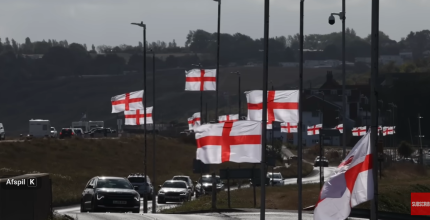
YouGov recently published a survey that has probably passed most Britons by. It asked what people associate with the English flag – St George’s Cross – and the results are striking. More than half of adults from ethnic minority backgrounds – 52 per cent – now believe that the flag has become a racist symbol, while 36 per cent of white Britons say the same. Only a minority in both groups disagree. When YouGov followed up by asking how the widespread display of flags over the summer – part of the grassroots campaign Raise the Colours – had been perceived, many respondents, both Britons and immigrants, said the displays primarily signalled something anti-migrant or anti-minority rather than healthy national pride.
A survey with a built-in interpretation
At the same time, the poll shows that the Union Jack does not provoke the same reaction: a clear majority considers it not to be racist. This makes YouGov’s decision to focus specifically on St George’s Cross all the more revealing. For the very moment the figures were published, they were framed by a headline that did not merely inform, but interpreted:
“England flag has become a racist symbol, say ethnic minority adults.”
It is a headline that tells us far more about YouGov’s agenda than about the public itself.
When the headline becomes a political message
The figures could easily have been presented far more neutrally. YouGov could have highlighted that the Union Jack is not widely seen as racist. They could have stressed that perceptions vary significantly between groups, or that Raise the Colours has sparked debate and competing interpretations. Instead, they chose the angle that most efficiently supports the government’s insistence that the use of St George’s Cross – and therefore Raise the Colours – is closely linked to racism and far-right motives. This is not editorial coincidence. It is political framing.
From national symbol to moral suspicion
And it works exactly as intended. When an institution like YouGov places the headline “the English flag is racist” at the top of its story, the flag becomes morally contaminated. It moves from being a national symbol to a suspicious marker, and from there it is only a short step to the next conclusion: those who use the flag must also be motivated by racism. In this way, the government can insist that Raise the Colours and Unite the Kingdom are not popular movements at all, but extreme, right-wing expressions of hatred – without ever having to say so outright. YouGov has already planted the association. The rest follows automatically.
A popular protest – not an extremist uprising
This is an extraordinarily effective way of crippling a protest movement. Not by banning it, but by making its symbolism morally dangerous. The hundreds of thousands of entirely ordinary English men and women who hung the flag out of their windows this summer did not do so to signal hatred. They did it because they feel their country slipping through their fingers. Many are reacting to mass immigration that is transforming the country without the population ever having been asked for a mandate; to Islamic dominance spreading deep into institutions and even into positions of political power; to an increasingly aggressive and censorious woke ideology; to 12,000 annual arrests for online speech; to an economy in free fall; and to a prime minister who seems to have decided that none of this constitutes a real problem. This is not extremism. It is desperation disguised as patriotism.
And it is precisely these people who are struck by YouGov’s framing. No one needs to stand up in Parliament and call them racists. It is sufficient to let an opinion-polling institute do it with a thin varnish of statistics. The outcome is the same: an entire segment of the population is rendered morally suspect for expressing love for their own country.
A country pushed towards its breaking point
The most serious issue, however, is not the survey itself, but the effect it has. It is not merely a mirror of the divisions that now characterise England. It actively intensifies them. When the state – through its media ecosystem and allied institutions – begins to define a national symbol as racist, it creates an identity conflict that no nation can sustain in the long run. The majority of the population is told that its patriotism is wrong, and that its cultural attachment is morally problematic. That does not generate reconciliation. It generates anger and resistance.
This is why it is no coincidence that, in recent months, people have begun speaking openly about the risk of civil-war-like conditions in England. Not because Britons desire such a future, but because they feel the distance between themselves and their own government growing larger by the day. When a state begins to fear its own population – and to stigmatise it – then it is not the population that has the problem. It is the state itself.