
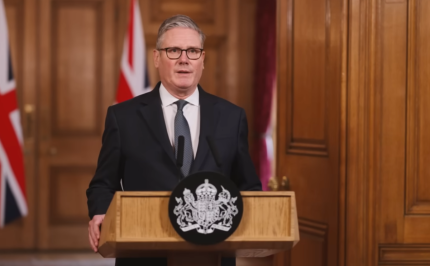
No one would accuse Keir Starmer of being a great statesman—let alone a competent prime minister. On the contrary: from the moment he took office in the summer of 2024, his approval ratings dropped like a stone from +10 to –57, where they have remained more or less stable ever since.
But one thing is that he is unpopular. Something far more ominous is his conduct in relation to the Iran war, where his zigzag policy has not only exposed what was once a strong and defense-ready England as outright weak, but has also raised questions about who actually holds domestic political power—and therefore defines Britain’s foreign policy.
When the United States requested access to British bases for operations against Iran’s clerical regime, Keir Starmer said no.
The United States sought access to, among other things, the strategically important base on Diego Garcia as well as other British installations in the region. Starmer rejected the request, citing international law and the experience of the Iraq war: Britain should not be drawn into yet another military conflict in the Middle East without careful consideration.
Then he changed his mind and allowed the United States to use the bases after all—but only for what he described as “defensive purposes.”
A few days later, a British base in Cyprus was struck by a drone in connection with the conflict.
Within a very short time, Britain had moved from a clear no to a hesitant yes and appeared as a country that neither spoke with one voice nor seemed entirely certain of its own strategic line. This prompted Donald Trump to remark pointedly that Starmer hardly appeared to be a Winston Churchill—and later to call him, quite bluntly, a loser.
A Pattern from the Gaza War
The Iran episode is not an isolated case. During the war in Gaza, a similar pattern could be observed in British politics.
Initially, Starmer emphasized Israel’s right to self-defense. Later, his statements were gradually softened after pressure from party colleagues and local politicians, and over time Labour also adjusted its position on the issues of a ceasefire and the recognition of Palestine.
A pattern therefore emerges in which a political position is first articulated and then adjusted when domestic political pressure increases. What is troubling is where that pressure comes from.
The 2024 Election Changed the Game
In the 2024 general election, independent Muslim candidates ran on the Gaza war as their main campaign issue. In Leicester and Blackburn they actually succeeded in defeating Labour candidates.
In other constituencies they received up to forty percent of the vote.
It is telling that it was considered a greater political shock for Labour to lose seats to independent candidates than the fact that demographic change in the country has become so substantial that Islam is not only making its presence felt electorally but can take seats from Labour on a distinctly Muslim political agenda.
The result is that Labour, with Starmer at its head, now allows its Middle East policy to be shaped more or less by powerful Muslim organizations. This became evident to anyone paying attention when Starmer, shortly after the attack on Iran’s clerical regime, met with representatives of a number of Muslim organizations in Britain and assured them that the government would do everything in its power to protect Muslim citizens and religious institutions in the country.
Demographic Change
If one wants to understand how much influence the Muslim population in Britain already has—and is likely to gain in the coming decades—the figures from the 2021 British census provide some important indications.
Around 3.9 million people—approximately 6.5 percent of the population of England and Wales—identify as Muslim. That represents an increase of about 44 percent in just ten years.
Projections from the Pew Research Center suggest that by the middle of this century the share could reach around 11 percent—or even higher depending on migration, which the Starmer government has shown little real willingness to curb.
At the same time, the Muslim population is significantly younger than the population as a whole. The median age is around 27 years, compared with about 40 years for the overall population.
In several British cities, the Muslim share of the population is already 20 to 30 percent—sometimes even higher.
It follows almost inevitably that conflicts in the Middle East increasingly acquire a domestic political dimension within British politics.
A Larger Question
The broader question is how demographic and political change affects a country’s strategic freedom of action.
Britain remains a central Western power and an important NATO ally. But if domestic politics increasingly sets limits on how far the government is willing to go in international conflicts, it will inevitably affect the country’s foreign policy direction.
Starmer’s zigzag policy during the Iran war—and his overtures toward powerful Muslim organizations—are, in any case, an ominous sign that we can no longer take Britain’s role in the Western alliance for granted in the future.