

A Writing Class at War with Reality
“In a way, Jeff Bezos is actually the worst,” read a column in the print edition of the Danish newspaper Information in February, written by journalist Mathias Sindberg. Before addressing why Bezos — the founder of Amazon — is supposedly “the worst,” it is worth considering who else is implicitly cast as villains in this company.
Like other unscrupulous billionaires, Bezos donated a million dollars to help finance Donald Trump’s inauguration. And like other unscrupulous billionaires, he sat in the front row at the ceremony itself.
Billionaires, then, are the worst — and they become entirely without conscience if they support the winner of a U.S. presidential election. Billionaires. Trump. Foolish majorities of voters. This is the spirit animating much of the writing class. In Denmark, parts of that class even write on the taxpayers’ tab, since media subsidies cover a portion of their salaries. And he who pays the piper…
Bezos as Saviour — and Scapegoat
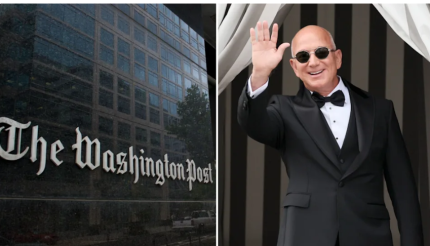
The struggling newspaper The Washington Post, with its excellent slogan “Democracy Dies in Darkness,” was purchased in 2013 by businessman Jeff Bezos for a quarter of a billion dollars. Many regarded it as a good deal at the time. Yet the paper continued to run losses as the economic foundation of print journalism eroded and the internet rendered the traditional omnibus format increasingly obsolete. Attempts to fix the business model have so far failed.
Ideological Conformity and the Flight of Readers
The Post’s initial survival strategy was to retain its core readership, which leaned left of the political centre. However, the increasingly insistent appeal to political consensus drove away ever more readers — and employees — who primarily wanted news and solid analysis rather than political advocacy. Glenn Kessler wrote in a Substack post titled Why I Left The Washington Post:
“Conservatives were an untapped market for growth, especially for a news organisation where traffic was falling. But there is a conundrum: if most of your readers are liberal, how do you attract conservatives without losing your existing base?”
He continued:
“The Washington Post readers who cared about politics and the federal government — most of them are liberal and probably would never watch Fox News. While it would be great to get a more balanced mix of liberal and conservative readers, I didn’t understand how one could attract conservative readers … without alienating existing readers.”
Former CNN host Don Lemon had little patience for attempts to reach audiences to the right of the far left, declaring that “Those folks are never going to watch any network that is a factual news organization.” Activist to the very end — if that is indeed what one wants — and an approach that makes it difficult to understand more than half the population, and thus the customer base as well.
Mark Halperin argued that The Washington Post presents itself as balanced, yet is written by a left-leaning journalistic class for a left-leaning audience. Summing up Kessler’s point, he quipped: “Yeah, our business model is that we are addicted to liberals.” Instead of writing for ideological camps, Halperin wisely suggested, the paper could strive to become a first-class newspaper — with solid journalism, scoops and strong columnists.
The Battle over the Business Model
Journalists and their remaining readers were, in this context, predictably outraged when Bezos decided that The Washington Post would not endorse a presidential candidate in the 2024 election — or rather, that it would not endorse the Democratic candidate, then Vice President Kamala Harris. On MSNBC’s talk show The View, panelists even celebrated those who cancelled their subscriptions in protest. The paper subsequently lost even more money.
I have previously written about this development, in which adherence to political orthodoxy is placed above the business model that sustains a newspaper — a format through which the press, as a watchdog of power, performs its role. Instead, journalists at The Washington Post concern themselves with how minorities — continually redefined and newly invented — are represented in its pages. This reluctance to face reality while ostensibly explaining reality to readers is something Sindberg himself exemplifies.
Revolt in the Newsroom and Mass Layoffs
Recently, nearly a third of The Washington Post’s staff were laid off — more than 300 people. The paper’s owner, Jeff Bezos, attempted to explain the decision with what must now be considered seven of the most dreaded words in the English language:
“The data tell us what is valuable.”
The dismissed employees protested outside the iconic newspaper building, insisting — like a modern army of the dispossessed — that it was their human right to remain employed. This reflects a segment of the writing class’s belief that they themselves determine what has value. Because one can write, one can invoke the barren word “data” without confronting what it actually represents: readers. “No one wants to read what you write!” the new editor had reportedly told them at a staff meeting the previous year.
Media Elites and Double Standards
“Bezos was welcomed with open arms when he bought The Post in 2013,” Sindberg writes, recalling the hopes of a new future in an increasingly harsh media landscape. Yet he later resorts to body-shaming the billionaire as “a small bald cannonball” and attacking his business practices.
Some ordinary people whose factory or retail jobs disappeared have found work at Amazon fulfilment centres. That is precisely what happens to Frances McDormand’s character Fern in the powerful 2020 film Nomadland. She takes a demanding and temporary job without dignity, security, community or many of the other elements workplaces once provided — a place where everything revolves around the customer and no one thinks about the worker.
With a heavy hand and what Sindberg describes as vulgar libertarian extremism, Bezos has allegedly tried systematically to crush any attempt by employees to unionise.
It was, according to this narrative, through such practices that the “bald cannonball” was able to buy The Washington Post in the first place — profits extracted from workers and then used to subsidise the humourless ideologues of the newspaper. And portraying social reality by referencing a feature film is hardly classical journalism of the kind immortalised in All the President’s Men.
From Watergate Glory to Downward Spiral
But the story becomes even worse, as RealClearPolitics founder Tom Bevan points out. There is rarely outrage in the media when large numbers of people in useful manual jobs are laid off — for example, the 16,000 employees Amazon dismissed, the very core business from which the money supporting The Washington Post’s pampered writers originates.
As Jonathan Turley observed:
“The campaign against Jeff Bezos is continuing as many demand that he sell the newspaper to another billionaire who will not order staff cuts or major changes in the culture. It is amazing how the left embraces liberal ‘oligarchs’ when they need a Soros-like subsidy… The Washington Post has been losing revenue and readers for years, but writers are irate that Bezos will not simply allow them to write for each other and an ever-contracting base.”
In another episode, a male Washington Post journalist jokingly retweeted, “All girls are bi — the question is whether they are polar or sexual!” He was forced to apologise; a younger female colleague argued that even his free time was not his own to manage. He was suspended for several months without pay. “Democracy dies in idiocy!” commented the left-leaning TV host Bill Maher.
Maher pointed to what he saw as the paper’s death spiral: management punished a talented journalist to appease the permanently offended. Reflecting on the 50th anniversary of the Watergate scandal — famously covered by Post reporters Bob Woodward and Carl Bernstein — he wondered how today’s journalists would react if someone calling himself “Deep Throat” asked to meet in a parking garage to discuss “something interesting.”